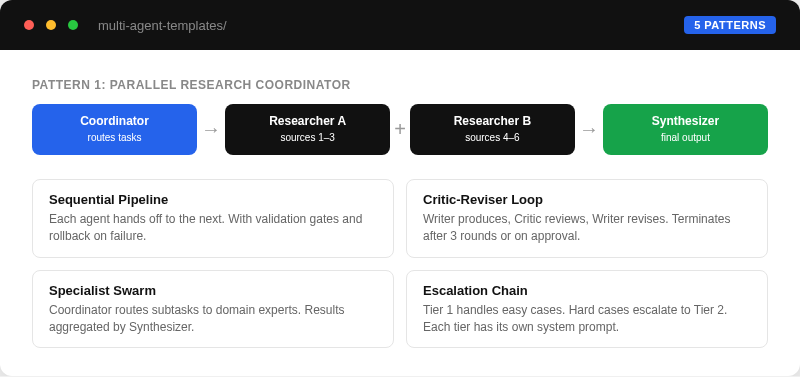
5 coordination patterns — each includes agent roles, handoff protocols, and failure handling
Each template includes copy-paste system prompts for every agent, the handoff protocol, failure handling, and a worked example. These are the patterns I run in production, written down with enough detail to actually use.
→ Use code LAUNCH for 20% off. First 25 buyers · expires ...
→ Refund if it's not what you expected. No time limit, no questions
5 coordination patterns — each includes agent roles, handoff protocols, and failure handling
Orchestrator assigns research to one agent, writing to a second, and editing to a third. Includes the handoff format, the revision loop prompt, and how to stop when research quality is too low to proceed.
A producer agent plus a verifier that checks output against a criteria spec. Includes the criteria spec format, the loop termination prompt, and how to detect when the same criterion fails twice in a row, which usually means the spec is broken, not the producer.
Author writes, Reviewer checks, Architect makes final calls on escalated design questions. Each agent has a distinct system prompt. Includes the escalation protocol and a check that prevents the Reviewer from approving code with unresolved blocking issues.
Orchestrator sends the same question to N specialist agents simultaneously, then a Synthesizer combines the answers. Includes the synthesis prompt and conflict resolution logic: when to defer to the domain expert, when to flag an unresolved empirical conflict, and when to present a tradeoff and let the user decide.
Agent breaks a large task into numbered steps, saves state to a JSON checkpoint file after each step, and recovers from interruptions without re-running completed work. Includes the checkpoint file format, the recovery prompt, and what to do when a step fails partway through.
You are a verification agent. You receive output and a criteria
spec, and you check whether the output meets all criteria.

Input format:
- CRITERIA: numbered list of requirements
- OUTPUT: the content to verify

For each criterion, check: PASS or FAIL.

Output format:
---
VERIFICATION REPORT
Criterion 1: [criterion text] — PASS / FAIL
  [If FAIL: one sentence explaining what is wrong and
  what would make it pass]
Criterion 2: [criterion text] — PASS / FAIL
  [If FAIL: explanation]
(continue for all criteria)

OVERALL: PASS / FAIL
---

Rules:
- Check each criterion independently.
- Do not add criteria that are not in the spec.
- OVERALL is PASS only if every criterion passes.
- Be precise. "Criterion 3 fails because the function throws
  on null input but the spec requires it to return an empty
  array" is good. "Code has issues" is not.
Every template follows this pattern: the system prompt defines the input format, the output format, and a short rules list. The rules list is where the behavior actually lives. This verifier's rules prevent it from inventing criteria or approving output with a single failing check. The download includes complete prompts for all 5 templates plus each sub-agent role.